
Shopping Cart
There are no more items in your cart

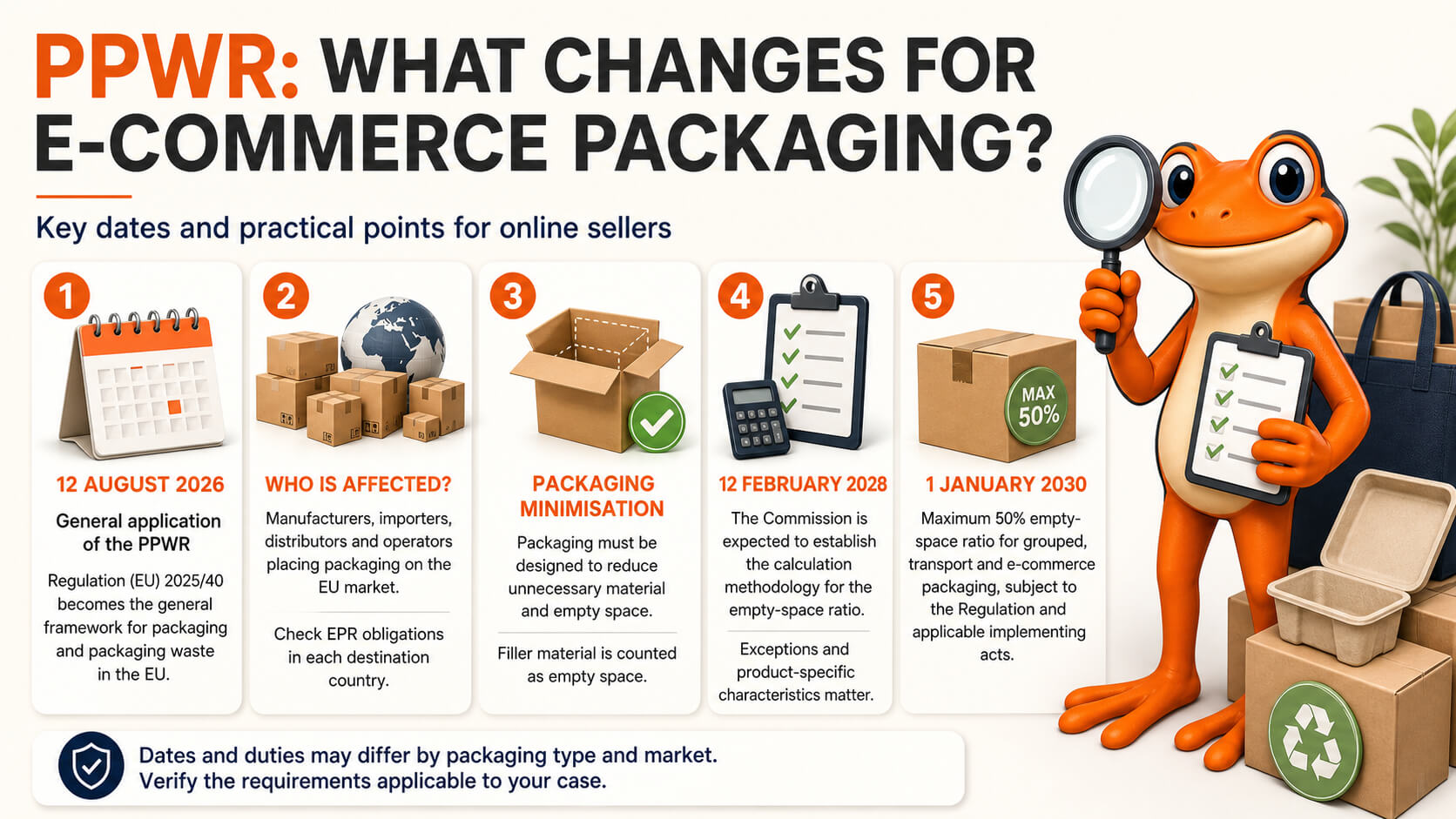
Regulation (EU) 2025/40, known as the Packaging and Packaging Waste Regulation (PPWR), introduces new European rules on packaging and packaging waste. The Regulation is generally applicable from 12 August 2026, but the individual obligations do not all start on the same date.
Important note on EPR: Extended Producer Responsibility itself is not being suspended. The European Commission has proposed suspending until 1 January 2035 the application of Article 45(3) of the PPWR, concerning the obligation to appoint an authorised EPR representative in other Member States for certain cross-border sales. This proposal must not be confused with a general suspension of EPR obligations.
For an e-commerce business selling within the European Union, the PPWR is particularly relevant because packaging compliance, national EPR schemes, local registrations and eco-contributions may all apply at the same time.
The PPWR applies to packaging of all kinds and materials, including:
An online retailer does not need to manufacture packaging itself to be affected. In particular, when products are sold directly to consumers in another EU Member State, the retailer may become the producer for EPR purposes in the destination market.
This distinction is essential.
The manufacturer of a cardboard box is normally responsible for technical packaging requirements, including design, composition, technical documentation and the applicable declaration of conformity.
The e-commerce business buying that box may nevertheless have separate EPR obligations when it uses the packaging to deliver goods to consumers in another Member State.
For example:
Buying compliant packaging from a supplier therefore does not automatically cover the retailer's EPR obligations in every EU country.
EPR – Extended Producer Responsibility means that the producer identified by the applicable legislation is responsible not only for placing packaging on the market, but also for contributing to the cost of managing the resulting packaging waste.
Depending on the country, EPR compliance may include:
A PRO – Producer Responsibility Organisation is an authorised organisation that manages packaging waste obligations collectively on behalf of producers.
Different countries use different terminology:
The eco-contribution finances the collection, sorting, recycling and management of packaging waste.
It may depend on:
The eco-contribution must be distinguished from the fee charged by an EPR consultant or authorised representative.
Article 45(3) of the PPWR provides, for certain cross-border situations, for the appointment of an authorised representative for Extended Producer Responsibility in each relevant Member State other than the country where the producer is established.
The representative may manage:
The European Commission has proposed suspending the application of this specific requirement until 1 January 2035.
However, there is an important unresolved issue: suspending Article 45(3) at EU level would not necessarily cancel national authorised-representative requirements that already exist. France, Spain, Austria and Belgium have national EPR rules concerning foreign sellers. These provisions must therefore continue to be checked country by country.
| Country | Packaging EPR | Main system | Authorised representative |
|---|---|---|---|
| France | Yes | ADEME / IDU + éco-organisme | Required in relevant cases for foreign producers subject to French EPR rules |
| Germany | Yes | LUCID + dual system | Generally not mandatory under the current national VerpackG system |
| Spain | Yes | Producer Register + SCRAP | Required in relevant cases |
| Austria | Yes | National register + recovery scheme | Required for relevant foreign distance sellers |
| Belgium | Yes | Fost Plus / Valipac | Required for certain foreign distance sellers |
| Netherlands | Yes | Verpact | No general equivalent requirement identified for ordinary packaging |
The PPWR does not establish fixed fees for EPR representatives. Costs depend on the national system, packaging volumes, materials and the private service provider used.
| Country | Typical cost structure | Indicative position for a small seller |
|---|---|---|
| France | Representative + éco-organisme + eco-contribution | From a few hundred euros per year; simplified EPR schemes may reduce the environmental contribution for very small volumes. |
| Germany | LUCID registration + dual system | LUCID registration is free; dual-system fees depend on material and weight. |
| Spain | Representative + registration + SCRAP contribution | Usually several hundred euros per year for very small sellers, plus contributions. |
| Austria | Representative + EPR scheme + possible authentication costs | Typically several hundred euros per year. |
| Belgium | Representative where applicable + Fost Plus or Valipac | Usually several hundred euros per year depending on the packaging flow. |
| Netherlands | Verpact contribution | Small ordinary-packaging volumes may fall below the standard contribution threshold. |
Important: the amounts above are indicative. Authorised-representative fees are commercial service fees, while eco-contributions are calculated according to the rules of the relevant national EPR system.
There is no general EU exemption from packaging EPR based solely on company turnover.
Member States may nevertheless provide thresholds, simplified procedures or lower contributions for small quantities.
Examples include:
The EU definition of a micro-enterprise generally refers to a business with fewer than 10 employees and annual turnover or annual balance-sheet total not exceeding EUR 2 million. This status, however, does not automatically remove packaging EPR obligations.
Another common misconception is that, from August 2026, e-commerce packages may no longer contain more than 50% empty space.
This is incorrect.
The Commission must first establish the calculation methodology. The specific 50% maximum empty-space ratio for grouped, transport and e-commerce packaging will apply from:
1 January 2030, or three years after the relevant implementing acts enter into force if that date is later.
Packaging fillers such as paper, bubble wrap, air cushions and foam count as empty space for the purposes of this ratio.
For shipments to the United Kingdom, Switzerland, the United States or other non-EU countries, PPWR obligations relevant to the EU business must still be considered, but the destination country's own packaging and EPR rules may also apply.
An EU-compliant package is therefore not automatically compliant with the rules of a non-EU market.
The PPWR requirement concerning authorised representatives in other Member States does not mean that an Italian online retailer automatically needs a “PPWR representative” in the United States, Switzerland or the United Kingdom. Local legislation must be checked separately.
This English version summarises the main issues for international readers.
For a more detailed analysis including deadlines, national EPR systems, estimated costs, sanctions, examples and the Italian regulatory context, read the complete Italian guide:
Read the complete PPWR e-commerce guide in Italian
Legal notice: the information contained in this article is provided for general informational and educational purposes only and does not constitute legal, tax or environmental advice. Packaging and Extended Producer Responsibility legislation is complex, evolves over time and may impose different obligations depending on the company's role, products, packaging materials and destination markets. Before taking operational or compliance decisions, businesses should verify the legislation currently in force and, where appropriate, obtain advice from a qualified professional or the competent national authority.


![[PrestaShop Module] View and filter and search orders by...](https://cdn.tecnoacquisti.com/531-home_default/-prestashop-module-view-and-filter-and-search-orders-by-shipping-mode-in-back-end.jpg)